

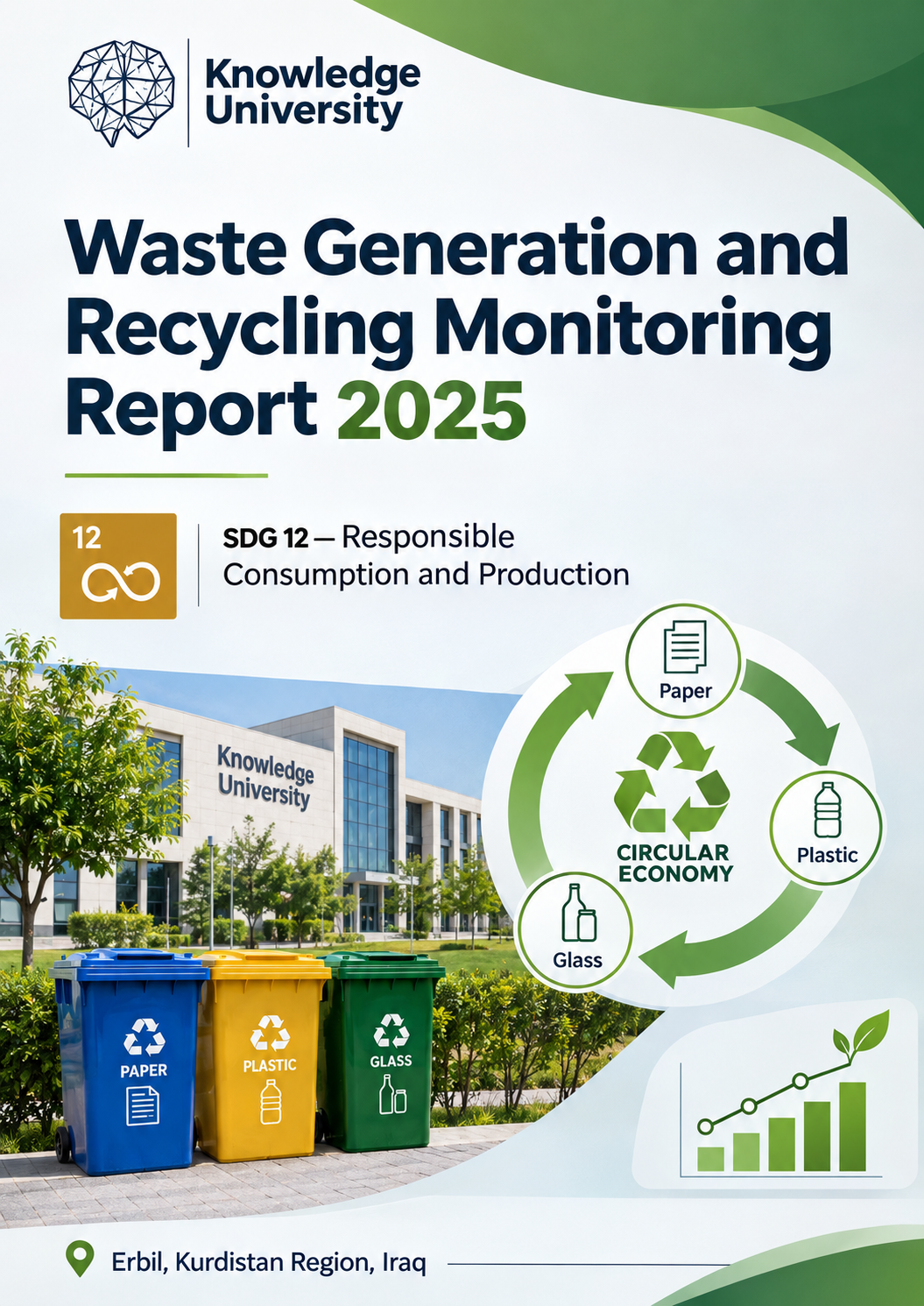
Knowledge University — Waste Generation and Recycling Monitoring Report 2025
SDG 12 — Responsible Consumption and Production
Institution: Knowledge University, Erbil, Kurdistan Region, Iraq
Reporting Period: 1 January – 31 December 2025
Report Preparation: November 2026
Responsible Office: Facilities & HSE Directorate
Institutional Oversight: Directorate of Quality Assurance & Accreditation
Report Status: Preliminary assessment — 2025 quantitative estimates pending verification
1. Overview
Knowledge University is committed to responsible waste management, waste minimisation, recycling and environmental sustainability in accordance with United Nations Sustainable Development Goal 12 (SDG 12): Responsible Consumption and Production.
The university has established an institutional waste-management framework covering the measurement of waste generated, waste sent to landfill and waste collected for recycling.
Knowledge University's published Sustainability & SDG Annual Report 2024 documents the implementation of a whole-university waste measurement policy and monthly monitoring of recycled and landfill waste.
The university's Waste Management & Recycling Measurement Policy establishes requirements for regular monitoring, appropriate recordkeeping, waste segregation and annual performance reporting.
This report reviews the established monitoring framework and presents a preliminary assessment of possible 2025 waste quantities based on the university's previously published baseline.
The 2025 estimates are provided for planning and internal assessment purposes and remain subject to confirmation against original collection and disposal records.
2. Institutional Waste Measurement Framework
Knowledge University's waste measurement framework covers waste generated through university activities and operations.
The institutional policy establishes requirements for:
- Monitoring quantities of waste generated.
- Recording waste sent to landfill.
- Measuring waste separately collected for recycling.
- Maintaining monthly monitoring records.
- Coordinating with relevant waste collection and recycling service providers.
- Evaluating recycling and landfill disposal performance.
- Preparing annual waste management summaries.
- Identifying opportunities to reduce waste and improve recycling.
The Facilities & HSE Directorate is the designated office responsible for coordinating operational monitoring.
The Directorate of Quality Assurance & Accreditation supports institutional oversight, documentation and sustainability reporting.
Official policy: Waste Management & Recycling Measurement Policy
3. Waste Measurement Coverage
The university's documented 2024 waste management framework identifies whole-university coverage.
The policy applies to waste associated with:
- Academic colleges and departments.
- Classrooms and educational facilities.
- University administrative offices.
- Libraries and student facilities.
- Scientific and teaching laboratories.
- Cafeterias and food-service areas.
- Common areas and outdoor spaces.
- Cleaning and maintenance operations.
- Other relevant university activities.
Historical monitoring coverage: Whole university, as documented in the 2024 Sustainability & SDG Annual Report.
2025 coverage verification status: Not independently established from publicly available 2025 monitoring records.
Monitoring frequency prescribed by the policy: Monthly, with annual reporting.
2025 operational confirmation: Original monthly collection and recycling records are required to establish actual monitoring coverage and frequency.
The institutional policy establishes the intended scope of waste monitoring. Confirmation of full implementation during 2025 requires corresponding operational evidence.
4. Waste Measurement Methodology
Knowledge University's monitoring framework is intended to distinguish waste generated from waste diverted for recycling and waste sent to final disposal.
For a verified annual assessment, appropriate supporting information includes:
- Recorded waste weights.
- Waste collection records.
- Waste collection service-provider reports.
- Recycling collection and transfer documentation.
- Landfill disposal records.
- Consistent estimates based on documented collection volumes, where direct weighing is unavailable.
Waste quantities should be reported in metric tons (mt).
Where measurement relies on estimated quantities rather than direct weights, the calculation method and underlying operational records should be documented.
The preliminary estimates in Section 5 are derived from the university's published 2024 annual figures and an illustrative growth assumption. They are not the result of independently verified 2025 waste collection measurements.
5. Preliminary Waste Generation and Recycling Assessment — 2025
5.1 Published Historical Baseline
Knowledge University's Sustainability & SDG Annual Report 2024 provides the following approximate university-wide waste figures:
| Waste Category | 2024 Amount |
|---|---|
| Total waste generated | 420 metric tons |
| Waste recycled | 126 metric tons |
| Waste sent to landfill | 294 metric tons |
| Recycling rate | 30% |
| Landfill disposal rate | 70% |
Source: Sustainability & SDG Annual Report 2024
5.2 Indicative 2025 Planning Scenario
To support preliminary planning, an illustrative increase of approximately 14.3% in total waste generation has been applied to the reported 2024 baseline.
This scenario considers the possibility of increased campus activity associated with higher student and employee numbers.
It assumes that the recycling rate remained at the 2024 level of 30%.
| Waste Category | Indicative 2025 Amount |
|---|---|
| Total waste generated | 480 metric tons |
| Waste recycled | 144 metric tons |
| Waste sent to landfill | 336 metric tons |
| Recycling rate | 30% |
| Landfill disposal rate | 70% |
Data classification: Illustrative estimates — not verified 2025 measurements.
These values must not be presented as actual annual waste quantities until supported by the university's operational records.
5.3 Calculation Method
Estimated total waste generated
420 mt × 1.142857 = approximately 480 mt
Estimated waste recycled
480 mt × 30% = 144 mt
Estimated waste sent to landfill
480 mt − 144 mt = 336 mt
Estimated recycling rate
(144 ÷ 480) × 100 = 30%
The scenario assumes that the entire non-recycled quantity was sent to landfill and that there were no additional waste treatment streams.
Where other disposal methods are documented, the final figures must be adjusted to reflect them.
6. Waste Segregation and Recycling
Knowledge University's Waste Management & Recycling Measurement Policy establishes requirements for segregating recyclable waste from general waste.
Materials relevant to campus recycling programmes may include:
- Paper and cardboard.
- Plastic bottles and packaging.
- Metal containers and recyclable metal waste.
- Glass products accepted by recycling providers.
- Suitable electronic waste.
- Other materials accepted by available recycling services.
The university's 2024 Sustainability Report documents the operation of monthly monitoring of recycled and landfill waste.
For 2025 reporting, the quantities collected and confirmed as recycled must be verified through appropriate collection records or recycling provider documentation.
Waste collected for recycling should not automatically be counted as successfully recycled when the final recycling outcome is unknown.
7. Waste Sent to Landfill
Waste sent to landfill represents the portion of generated waste disposed of rather than recycled.
Knowledge University's policy establishes separate monitoring of landfill and recycling waste.
Under the preliminary 2025 scenario, the estimated landfill quantity is 336 metric tons.
This estimate is based on the assumption that total waste generation was 480 metric tons and the recycling rate remained 30%.
For verified reporting, landfill quantities should be reconciled against collection records and available disposal documentation.
For THE reporting purposes, incineration without energy recovery is included in landfill disposal quantities, while verified energy recovery may be reported under the relevant recycling category according to the applicable methodology.
8. Monitoring and Institutional Responsibilities
Facilities & HSE Directorate
The Directorate is designated to coordinate:
- Waste collection and segregation arrangements.
- Monitoring of landfill and recyclable waste.
- Monthly waste recording.
- Coordination with waste collection providers.
- Preparation of annual waste monitoring information.
- Identification of operational improvement opportunities.
Directorate of Quality Assurance & Accreditation
The Directorate supports:
- Institutional sustainability documentation.
- Monitoring of applicable policies.
- Coordination of environmental reporting.
- Review of evidence used for institutional accreditation and sustainability ratings.
- Continuous improvement and policy evaluation.
Academic and Administrative Departments
University departments are expected to support responsible waste management, appropriate waste segregation and cooperation with relevant monitoring procedures.
9. Environmental Sustainability and Continuous Improvement
Knowledge University aims to strengthen waste management through:
- Improved segregation of recyclable materials.
- Reduction of unnecessary disposable products.
- Responsible procurement and material consumption.
- Increased use of reusable alternatives.
- Improved waste collection documentation.
- Cooperation with waste collection and recycling service providers.
- Awareness activities for students and staff.
- Improved reporting of waste quantities and recycling performance.
The university's Plastic Waste Reduction Policy, Disposable Materials Reduction Policy and Ethical Sourcing & Procurement Policy provide additional institutional frameworks supporting these objectives.
Related University Policies
- Waste Management & Recycling Measurement Policy
- Plastic Waste Reduction Policy
- Disposable Materials Reduction Policy
- Ethical Sourcing & Procurement Policy
10. Data Quality and Verification
Knowledge University recognises the importance of transparent, accurate and consistent sustainability reporting.
The published 2024 figures provide a historical basis for evaluating changes in institutional waste generation.
The preliminary 2025 scenario in this report is based on extrapolation from that baseline rather than verified collection records.
A final 2025 measurement report requires reconciliation of available records, including:
- Waste collection quantities.
- Recycling transfer and processing records.
- Landfill disposal documentation.
- Facilities and departments covered.
- Monitoring frequency and methodology.
Any verified annual results should replace the preliminary estimates before they are reported as measured institutional performance.
11. Conclusion
Knowledge University has established an institutional framework for waste generation measurement, recycling monitoring and responsible waste disposal.
Its published 2024 Sustainability & SDG Annual Report documents whole-university waste measurement, including approximately 420 metric tons of waste generated and a 30% recycling rate.
For 2025, this preliminary report presents an illustrative waste generation scenario of 480 metric tons, including 144 metric tons recycled and 336 metric tons sent to landfill.
These estimates illustrate possible changes associated with increasing campus activity. They do not establish actual 2025 performance.
Knowledge University continues to prioritise responsible consumption, recycling, waste reduction and the development of reliable institutional sustainability information.
12. References
1. Knowledge University — Sustainability & SDG Annual Report 2024
https://knu.edu.iq/campus?campusId=23
2. Waste Management & Recycling Measurement Policy
https://knu.edu.iq/single_policy?id=24
3. Plastic Waste Reduction Policy
https://knu.edu.iq/single_policy?id=17
4. Disposable Materials Reduction Policy
https://knu.edu.iq/single_policy?id=25
5. Ethical Sourcing & Procurement Policy
https://knu.edu.iq/single_policy?id=22
Knowledge University
Erbil, Kurdistan Region, Iraq
Official Website: https://knu.edu.iq/
Related Sustainable Development Goal: SDG 12 — Responsible Consumption and Production
Report Status: Preliminary 2025 assessment; numerical estimates require verification before use as measured annual results.