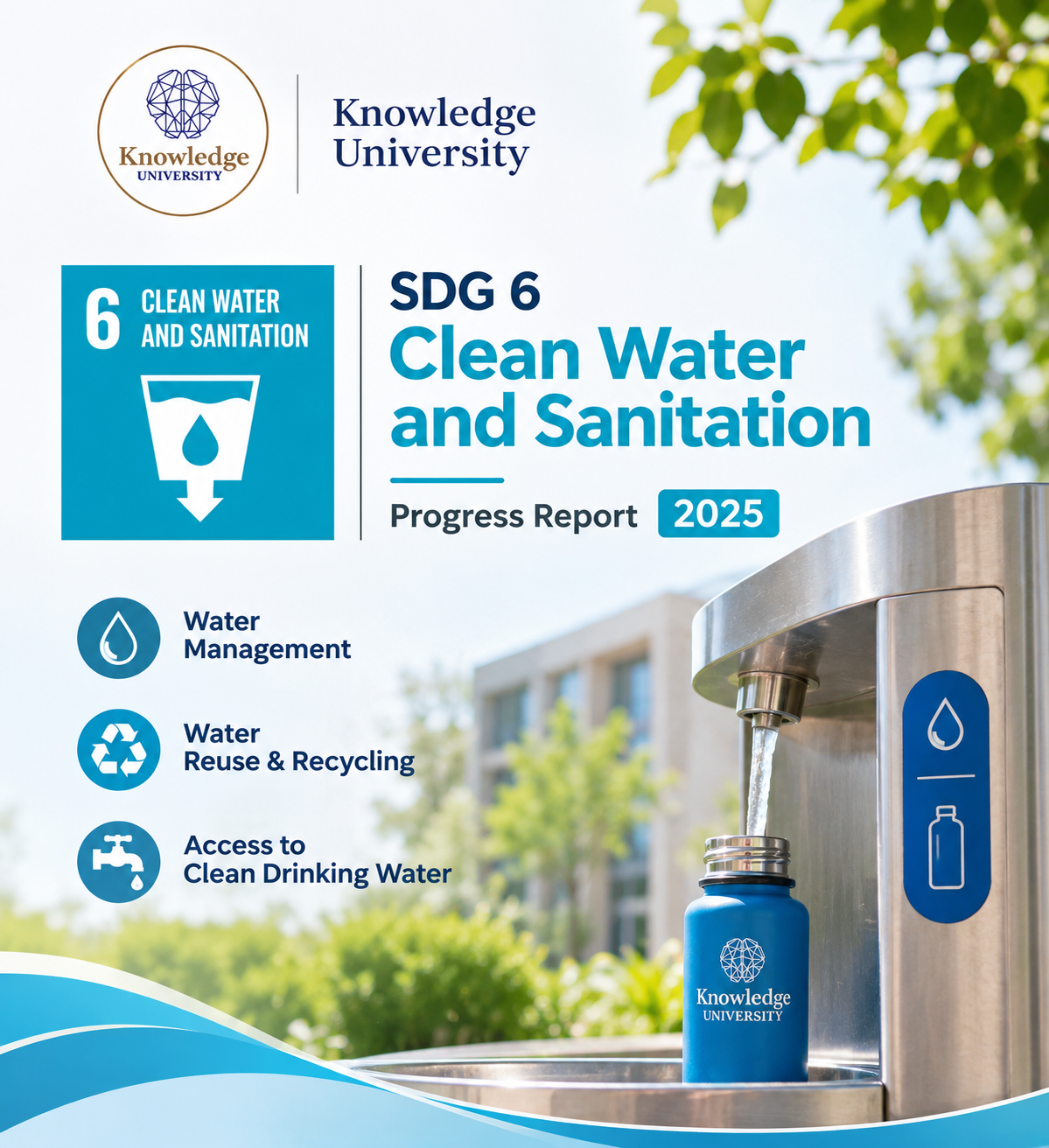
Knowledge University — SDG 6: Clean Water and Sanitation Progress Report 2025
United Nations Sustainable Development Goal 6: Clean Water and Sanitation
Reporting Period: January–December 2025
Institution: Knowledge University, Erbil, Kurdistan Region, Iraq
Report Type: Institutional Sustainability Progress Report
Related SDGs: SDG 3 — Good Health and Well-being; SDG 6 — Clean Water and Sanitation; SDG 9 — Industry, Innovation and Infrastructure; SDG 11 — Sustainable Cities and Communities; SDG 12 — Responsible Consumption and Production; SDG 13 — Climate Action; SDG 17 — Partnerships for the Goals
1. Executive Summary
Knowledge University recognises the importance of Sustainable Development Goal 6 (SDG 6): Clean Water and Sanitation, which aims to ensure the availability and sustainable management of water and sanitation for all.
Water security is an important environmental and development challenge in the Kurdistan Region of Iraq. Sustainable water management requires responsible consumption, protection of water resources, pollution prevention, research, education and cooperation between universities and relevant institutions.
Knowledge University contributes to SDG 6 through its published campus water-management arrangements, environmental policies, water-related academic education, scientific research and engagement with governmental and international organisations.
During 2025, the university organised and participated in activities addressing water security, environmental pollution, groundwater management, sustainability and environmental governance.
These included a high-level meeting on climate change and water security, a scientific seminar on groundwater-level prediction, cooperation discussions with UNICEF and engagement with regional environmental authorities.
Knowledge University also maintains previously documented arrangements for water consumption monitoring, water reuse measurement, drinking-water provision and water-efficient building design.
This report presents the university's documented contributions during 2025, distinguishes current activities from earlier institutional arrangements and identifies additional information required to measure water-management performance.
2. SDG 6 Progress Highlights — 2025
| Area | Documented Progress or Institutional Evidence |
|---|---|
| Water security dialogue | High-level meeting involving the Governor of Erbil and environmental specialists |
| Government cooperation | Meetings and engagement with regional environmental authorities |
| International engagement | Discussions with UNICEF on potential water-resource project cooperation |
| Groundwater education | Scientific seminar on artificial-intelligence prediction of groundwater levels |
| Research | Scientific publication examining climate and land-use impacts on groundwater |
| Pollution awareness | Panel on environmental pollution and public health |
| Environmental education | Student participation in an environmental governance and plastic-pollution workshop |
| Water consumption monitoring | Existing campus water-meter monitoring framework documented in 2024 |
| Water reuse measurement | Existing monthly reused-water monitoring framework documented in 2024 |
| Access to drinking water | Existing university provision of free drinking-water dispensers |
| Water-efficient infrastructure | Sustainable building standards covering water-saving fixtures |
| Institutional policy | Water Discharge Quality Standards & Guidelines Policy listed on the university website in 2025 |
The above information describes documented activities and publicly available institutional arrangements.
Actual campus water consumption, wastewater treatment, water reuse quantities and reductions in water use during 2025 require verification using university operational records.
3. Campus Water Consumption Monitoring
3.1 Water Usage Monitoring and Measurement
Knowledge University has published a campus water monitoring framework designed to support responsible consumption and sustainable resource management.
The university's Facilities & Projects Directorate is identified as the office responsible for collecting and reviewing water consumption information.
According to the institutional webpage dated 13 October 2024, the university's monitoring approach includes:
- Water meters at main campus supply points and key buildings.
- Monthly recording of water consumption.
- Monitoring of water supplied through the municipal mains network.
- Preparation of annual water-consumption summaries.
- Identification of areas where water-saving improvements may be needed.
This monitoring arrangement provides an institutional foundation for tracking water demand and planning future resource-efficiency measures.
The published description refers to the university's monitoring arrangements in 2024.
Confirmation of their operation throughout 2025, including the annual volume of water consumed, requires the corresponding Facilities & Projects Directorate records.
Institutional evidence: Water Usage Monitoring & Measurement at Knowledge University
4. Water Reuse and Recycling
4.1 Monitoring Reused Water
Knowledge University has previously published information describing the measurement of reused water across campus operations.
The institution's reused-water monitoring framework identifies the Facilities & Projects Directorate as responsible for preparing monthly measurement records.
According to the university's 2024 webpage, the monitoring approach includes water reused for landscape irrigation and external cleaning activities.
The stated purpose is to quantify water reused in university operations and support decisions that may reduce dependence on freshwater resources.
The existing framework contributes to SDG 6 by establishing the importance of monitoring water reuse.
However, the available webpage does not publish the total volume of water actually reused during 2025.
The annual reused-water quantity, sources of reused water and operational arrangements require verification through institutional records.
Institutional evidence: Monitoring Reused Water at Knowledge University
4.2 Water Reuse & Recycling Policy
Knowledge University lists a Water Reuse & Recycling Policy among its official institutional policies.
The webpage identifies the policy document with a date of 10 November 2025.
The policy's title demonstrates institutional attention to water conservation and reuse.
For comprehensive public reporting, the approved policy document should be made accessible, together with verified information on its implementation and actual water reuse activities.
Policy reference: Water Reuse & Recycling Policy
5. Provision of Free Drinking Water
Knowledge University has previously published information regarding the availability of free drinking water on campus.
The institutional webpage dated 11 November 2024 describes drinking-water dispensers installed in key university buildings.
The service is intended for:
- Students.
- Academic staff.
- Administrative employees.
- Campus visitors.
Access to drinking water is an important component of a healthy and supportive educational environment.
The university's existing provision is relevant to SDG 6 and SDG 3, which address clean water, health and well-being.
The original webpage documents the established service arrangements. Confirmation of service continuity and maintenance during 2025 requires updated facilities records.
Institutional evidence: Free Drinking Water Campus
6. Water-Efficient Buildings and Infrastructure
Knowledge University has published Sustainable Building Standards describing environmental requirements for new university buildings and major renovation projects.
The framework, introduced in 2024, addresses resource efficiency during building planning, design and construction.
Among its stated requirements are water-saving fixtures in new indoor installations.
The framework also addresses energy efficiency, construction materials and other environmental considerations.
The Facilities & Projects Directorate is responsible for overseeing implementation during university construction and renovation projects.
These arrangements establish a documented institutional approach to water-conscious building design.
Records of water-efficient fixtures installed during 2025, including project specifications and completion reports, would provide stronger evidence of implementation.
Institutional evidence: Sustainable Building Standards at Knowledge University
7. Water Pollution Prevention and Discharge Management
7.1 Water Discharge Quality Standards Policy
Knowledge University lists a Water Discharge Quality Standards & Guidelines Policy within its official policy collection.
The webpage identifies a policy document dated 10 November 2025 and provides access to a linked PDF.
The policy is relevant to the university's institutional framework for addressing water quality and responsible wastewater discharge.
Effective pollution prevention also requires operational procedures, appropriate handling of wastewater and potentially hazardous substances, and documented monitoring or inspection.
Confirmation of the policy's detailed provisions and evidence of their implementation during 2025 should be retained by the relevant university offices.
Policy reference: Water Discharge Quality Standards & Guidelines Policy
7.2 Wastewater Treatment
Wastewater treatment is an important element of sustainable water management.
Knowledge University's Environmental Engineering Department provides education and academic knowledge relating to environmental protection, water systems and wastewater engineering.
However, educational programmes and research activities do not by themselves demonstrate that the university operated a wastewater treatment system.
The available public evidence reviewed for this report does not establish the type, capacity or operational performance of an on-campus wastewater treatment process during 2025.
Additional operational documentation would be needed to evaluate this aspect of the university's SDG 6 performance.
8. Environmental Pollution and Public Health Awareness
Panel Discussion on Environmental Pollution — 9 February 2025
On 9 February 2025, Knowledge University's Department of Environmental Engineering, in collaboration with the Kurdistan-Germany Friendship Association, organised a scientific panel titled:
“The Impact of Environmental Pollution on Citizens' Health: Causes and Solutions.”
The panel brought together researchers, environmental specialists, academic staff and students to discuss environmental pollution and its consequences for public health.
Topics included air and water pollution, industrial waste and climate change.
Participants discussed pollution sources, environmental risks and potential technological and policy-related responses.
The programme supported knowledge exchange and public awareness concerning environmental challenges that can affect drinking-water quality and human health.
The activity contributes to SDG 6 through water-pollution awareness and is also relevant to SDG 3 and SDG 13.
Published evidence: Panel Discussion on Environmental Pollution and Public Health
9. Cross-Sectoral Dialogue on Climate Change and Water Security
High-Level Meeting — 27 April 2025
On 27 April 2025, Knowledge University's College of Engineering hosted a high-level meeting addressing climate change and water security.
The meeting involved:
- Mr. Omed Khoshnaw, Governor of Erbil.
- Mr. Masoud Karash, Deputy Governor and Head of the Kurdistan Regional Environmental Protection Team.
- Prof. Dr. Ahmad Dezaye, President of Knowledge University.
- Members of the Board of Trustees.
- Academic and administrative staff.
- Specialists in water security, agriculture and environmental studies.
The meeting examined challenges associated with climate change and water-resource insecurity.
Participants highlighted the importance of maintaining access to sufficient and safe water resources while responding to environmental pressures.
The event provided an opportunity for dialogue between academic experts and government representatives regarding regional environmental and water-security concerns.
This activity demonstrates Knowledge University's contribution to cross-sectoral discussion relevant to SDG 6, SDG 13 and SDG 17.
The public announcement documents dialogue and stakeholder participation. It does not establish that a new water-management policy or infrastructure project resulted directly from the meeting.
Published evidence: College of Engineering Hosts a High-Level Meeting on Climate Change and Water Security
10. International Engagement on Water Resource Management
Knowledge University and UNICEF — 1 September 2025
On 1 September 2025, Knowledge University hosted representatives of UNICEF to discuss potential cooperation relating to water-resource management and university service projects.
The meeting involved the university's leadership and UNICEF representatives, including a hydrology officer and the operations manager of the Erbil office.
Discussions addressed possible financial and operational cooperation that could support university faculty involvement in water-resource projects in Erbil.
The participants also considered requests and opportunities for future coordination.
This engagement demonstrates Knowledge University's interest in connecting academic expertise with international organisations working on sustainable development challenges.
The meeting is relevant to SDG 6 and SDG 17 through international dialogue about water-resource management.
However, the official announcement describes discussions and planning. It does not independently verify the implementation or completion of a joint UNICEF water project during 2025.
Published evidence: Knowledge University Visits UNICEF for Collaboration on Water Resources Projects
11. Scientific Education on Groundwater Management
Artificial Intelligence Prediction of Groundwater Levels — 6 July 2025
On 6 July 2025, Knowledge University's Department of Computer Engineering organised a scientific seminar entitled:
“Artificial Intelligence Prediction of Groundwater Levels in the Shamamak Area, Erbil Region (2025–2045).”
The seminar was presented by Ms. Sazan Kamal at the university's Main Building.
The session was attended by academic staff and representatives of different departments within the College of Engineering.
The seminar explored the use of artificial intelligence in forecasting changes in groundwater levels.
Groundwater prediction is relevant to long-term water-resource planning because it supports scientific understanding of possible changes in underground water availability.
The activity demonstrates the university's contribution to scientific discussion about groundwater management and emerging predictive technologies.
Published evidence: Scientific Seminar on Artificial Intelligence Prediction of Groundwater Levels
12. Research Contributions to Sustainable Water Management
12.1 Groundwater, Climate Change and Land Use
Knowledge University's scientific publication records include a 2025 research paper entitled:
“Assessing the Influence of Climate and Land Use/Land Cover Changes on Groundwater Levels in Arid and Semi-Arid Regions: A Geoinformatics-Based Machine Learning Approach in the Iraqi Kurdistan Region.”
The university's research database lists the publication under 26 May 2025.
The research examines the relationship between climate variation, land-use changes and groundwater levels using geoinformatics and machine-learning methods.
The study addresses challenges relevant to sustainable groundwater management in the Kurdistan Region.
Its scientific contribution is relevant to understanding groundwater vulnerability and supporting evidence-based planning.
The publication represents a research contribution and should not be interpreted as evidence that its recommendations were implemented by public authorities during 2025.
Published evidence: Knowledge University Scientific Publications
12.2 Research on Wastewater Pollution Removal
Knowledge University's scientific publication records also include research examining the use of magnetic nanoparticles to remove organic and inorganic pollutants from wastewater.
The study reviews potential applications of advanced materials in wastewater treatment.
Such research contributes to the development of scientific knowledge about water purification and pollution control.
The publication supports research-related progress toward SDG 6.
It does not demonstrate the operation of a wastewater treatment facility at Knowledge University.
Research reference: Use of Magnetic Nanoparticles for the Removal of Organic and Inorganic Pollution in Wastewater Treatment — A Review
13. Environmental Governance and Institutional Cooperation
13.1 Engagement with Environmental Protection Authorities — 10 February 2025
On 10 February 2025, a delegation led by Engineer Abdulrahman Siddiq, Chairman of the Environmental Protection and Repair Board, visited Knowledge University.
The university's leadership received the delegation for discussions concerning cooperation with the Department of Environmental Engineering.
Topics included environmental sustainability, possible joint research activities, student involvement and institutional collaboration.
The meeting demonstrated engagement between the university and the regional environmental sector.
Published evidence: Environmental Protection and Repair Board Visits Knowledge University
13.2 Environmental Governance and Plastic Pollution Training — 15 April 2025
On 15 April 2025, Knowledge University reported the participation of Environmental Engineering student Ahmad Qais in a training workshop concerning environmental governance and plastic pollution.
The workshop was organised by the German organisation GIZ in connection with the Kurdistan Regional Government's Environmental Protection and Rehabilitation Board.
The student presented lessons from the training programme under the supervision of academic staff from Knowledge University's College of Engineering.
The presentation addressed plastic pollution, environmental governance and the role of education and youth participation in environmental protection.
The activity contributed to the university's engagement in regional environmental education and cooperation.
Published evidence: Knowledge University Student Presents at Seminar on Environmental Governance and Plastic Pollution
13.3 Environmental Cooperation Planning — 10 December 2025
On 10 December 2025, a delegation from Knowledge University's College of Engineering visited the Environmental Protection and Improvement Directorate.
The delegation included Assist. Prof. Dr. Marwan Aziz, Dean of the College of Engineering; Ms. Diana Aziz, Head of Environmental Engineering; and Dr. Rebwar Nasser.
During the meeting, both sides discussed possible joint projects and collaborative plans.
According to the university's announcement, the institutions agreed to organise scientific, awareness and community activities during 2026.
This meeting demonstrates institutional planning and cooperation in environmental management during 2025.
The proposed activities are future commitments rather than completed 2025 project outcomes.
Published evidence: College of Engineering Delegation Visits Environmental Protection and Improvement Directorate
14. Academic Education Supporting SDG 6
Knowledge University's Department of Environmental Engineering provides academic education relevant to water resources, environmental protection and wastewater management.
The published programme curriculum includes subjects such as Water Supply Engineering, environmental management and wastewater-related engineering topics.
These educational areas contribute to preparing future professionals with knowledge relevant to water quality, sanitation, treatment systems and sustainable resource use.
The university's academic provision supports SDG 6 through engineering education and the development of technical expertise.
Verification of the exact courses delivered during the 2025 academic year requires the corresponding approved coursebooks and academic records.
Institutional evidence: Department of Environmental Engineering
15. Assessment of SDG 6 Progress During 2025
Knowledge University's documented activities during 2025 demonstrate contributions in four main areas.
Water security and environmental dialogue: The university hosted meetings and discussions involving government authorities, environmental specialists and academic experts.
Groundwater research and education: The university supported scientific investigation and knowledge exchange on groundwater prediction, climate change and resource management.
International and institutional engagement: Knowledge University discussed cooperation with UNICEF and regional environmental institutions concerning water-resource and sustainability challenges.
Institutional water management: Previously documented campus frameworks address water consumption monitoring, water reuse measurement, drinking-water provision and water-efficient building standards.
Together, these activities and arrangements demonstrate the university's engagement with sustainable water management through research, education, institutional planning and community-oriented dialogue.
The available evidence is strongest for completed educational activities and established institutional frameworks.
A comprehensive assessment of operational progress during 2025 requires verified measurements of water consumption, water reuse, water quality and relevant infrastructure performance.
16. Monitoring and Institutional Performance
Knowledge University recognises the importance of quantitative monitoring when evaluating progress toward SDG 6.
The following information should be consolidated to support annual institutional sustainability reporting.
| Performance Indicator | Reporting Status |
|---|---|
| Total campus water consumption during 2025 | Requires verified annual meter readings |
| Campus population during 2025 | Requires official student and employee FTE data |
| Water consumption per campus person | Requires verified water volume and population data |
| Volume of water reused during 2025 | Requires verified reused-water monitoring records |
| Number of buildings covered by water monitoring | Requires confirmation from Facilities & Projects Directorate |
| Drinking-water availability and maintenance during 2025 | Requires updated facilities and maintenance records |
| Water-saving fixtures installed during 2025 | Requires building project and installation records |
| Wastewater treatment arrangements | Requires verified operational documentation |
| Water pollution prevention and inspection | Requires approved procedures and implementation records |
| Water-related community education activities | Documented activities identified; beneficiary counts require confirmation |
| Water-related research contributions | Scientific publication records available |
| Water-security cooperation with external organisations | Meetings documented; project implementation requires separate evidence |
The earlier institutional water-monitoring framework provides an important basis for future reporting.
Annual results should be drawn from original measurement records rather than estimated or reconstructed solely from earlier ranking submissions.
17. Priorities for Continuous Improvement
Knowledge University identifies the following opportunities for strengthening its future contributions to SDG 6.
Water measurement: Consolidate annual water-consumption figures from campus meters into a verified institutional report.
Water reuse: Document the sources, volumes and uses of recycled or reused water and monitor their contribution to freshwater conservation.
Water infrastructure: Strengthen recording of water-saving fixtures, drinking-water facilities and any implemented wastewater treatment arrangements.
Environmental protection: Maintain accessible approved policy documents and clear procedures for responsible water discharge and pollution prevention.
Academic research: Continue research addressing groundwater vulnerability, water quality, wastewater treatment and sustainable resource management.
Community education: Expand and document educational activities concerning responsible water use, pollution prevention and water security.
Institutional cooperation: Develop measurable project outcomes from engagement with governmental, non-governmental and international organisations.
Public reporting: Continue publishing institutional sustainability progress reports using verified annual performance information.
18. Conclusion
During 2025, Knowledge University contributed to SDG 6 — Clean Water and Sanitation through scientific research, environmental education, cross-sectoral dialogue and cooperation discussions related to water-resource management.
The university hosted a high-level meeting on water security, delivered academic discussion on groundwater prediction and participated in environmental governance activities.
It also engaged with governmental environmental bodies and UNICEF representatives concerning opportunities for cooperation.
Knowledge University's previously documented campus water-monitoring, water reuse, drinking-water and sustainable-building arrangements provide a foundation for institutional water stewardship.
The university recognises that future progress reporting should be supported by reliable operational data, including annual water consumption, reuse quantities and measurable improvements in water efficiency.
Knowledge University remains committed to advancing water-related research, sustainable resource management, environmental awareness and cooperation addressing regional water challenges.
19. Official References and Supporting Evidence
Campus Water Management and Policies
- Water Usage Monitoring & Measurement at Knowledge University — 2024 institutional monitoring framework.
- Monitoring Reused Water at Knowledge University — 2024 institutional monitoring framework.
- Free Drinking Water Campus — 2024 institutional service information.
- Sustainable Building Standards — 2024 institutional framework.
- Water Discharge Quality Standards & Guidelines Policy — listed in November 2025.
- Water Reuse & Recycling Policy — listed in November 2025; policy document accessibility requires correction.
University Activities During 2025
- Panel Discussion on Environmental Pollution and Public Health — 9 February 2025
- Environmental Protection Board Visits Knowledge University — 10 February 2025
- Environmental Governance and Plastic Pollution Training — 15 April 2025
- High-Level Meeting on Climate Change and Water Security — 27 April 2025
- Artificial Intelligence Prediction of Groundwater Levels — 6 July 2025
- UNICEF Water Resources Cooperation Meeting — 1 September 2025
- Environmental Cooperation Planning Meeting — 10 December 2025
Research and Education
- Knowledge University Scientific Publications — groundwater and wastewater-related research publications.
- Department of Environmental Engineering — academic programme and curriculum information.
Knowledge University
Erbil, Kurdistan Region, Iraq
Official Website: https://knu.edu.iq/
Reporting Year: 2025
Institutional Sustainability and SDG Progress Reporting