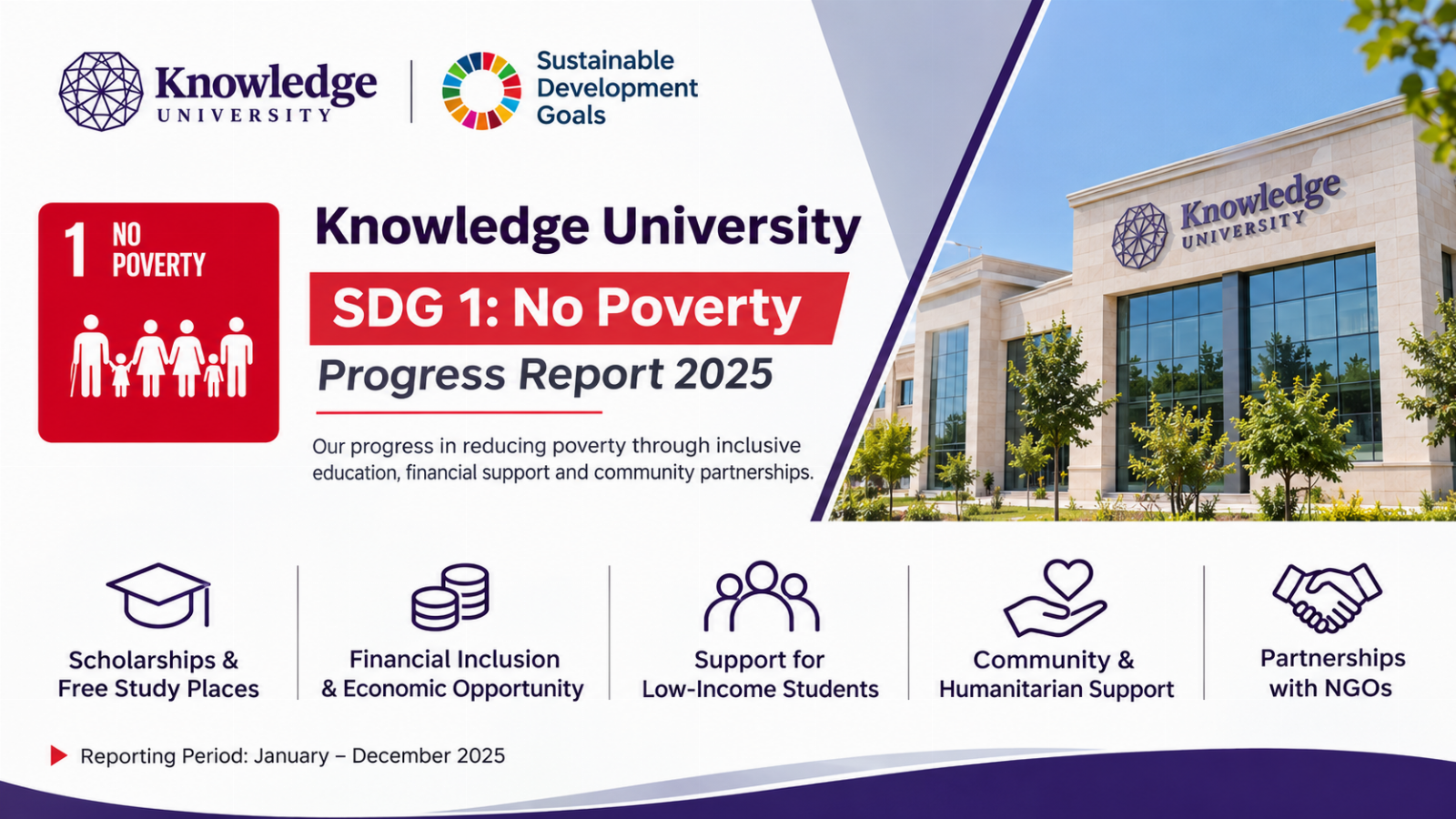
Knowledge University — SDG 1: No Poverty Progress Report 2025
United Nations Sustainable Development Goal 1: No Poverty
Reporting Period: January–December 2025
Institution: Knowledge University, Erbil, Kurdistan Region, Iraq
Report Type: Institutional Sustainability Progress Report
Related SDGs: SDG 1 — No Poverty; SDG 4 — Quality Education; SDG 8 — Decent Work and Economic Growth; SDG 10 — Reduced Inequalities; SDG 17 — Partnerships for the Goals
1. Executive Summary
Knowledge University recognises the importance of Sustainable Development Goal 1 (SDG 1): No Poverty, which aims to end poverty in all its forms everywhere.
As a higher education institution, Knowledge University contributes to poverty reduction by expanding access to education, supporting financially disadvantaged students, promoting financial inclusion and participating in initiatives that assist vulnerable communities.
During 2025, Knowledge University demonstrated its commitment through free scholarship opportunities, collaboration with charitable and educational organisations, financial-literacy initiatives and humanitarian assistance.
This report presents the university's documented SDG 1-related activities during 2025, together with its existing institutional framework for supporting students from low-income backgrounds.
2. Progress Highlights — 2025
| Key area | Documented activity or result |
|---|---|
| Access to higher education | 16 free scholarships announced jointly by Knowledge University and Knowledge Institute for 2025–2026 |
| NGO educational collaboration | 10 free academic study places contributed through the Rwanga Foundation |
| Financial inclusion | Exhibition involving more than 30 banks in collaboration with the Central Bank of Iraq — Erbil Branch |
| Humanitarian educational assistance | School supplies and educational materials distributed through collaboration with charitable organisations |
| Community financial assistance | Participation in a collective relief initiative for flood-affected people in Chamchamal |
| Charitable community support | Fundraising festival supporting thalassemia patients in Erbil |
The scholarship figures above describe separate initiatives. They are not presented as the number of unique students enrolled or receiving financial aid because beneficiary records and possible overlap have not been established in the published sources.
3. Expanding Access to Higher Education for Disadvantaged Students
3.1 Free scholarships for the 2025–2026 academic year
On 9 October 2025, Knowledge University and Knowledge Institute announced 16 free scholarships for Grade 12 graduates for the academic year 2025–2026.
The initiative was introduced under the supervision of Mr. Dashti Haji Najmaddin, Chairman of the Board of Trustees, with priority given to students from disadvantaged backgrounds, including families of martyrs, Anfal victims and individuals affected by ISIS.
The announced opportunities consisted of:
- 6 free university study places in selected academic programmes.
- 10 free institute study places in selected technical and vocational programmes.
This initiative was designed to reduce the financial barriers preventing vulnerable students from accessing higher education.
By creating tuition-free educational opportunities, Knowledge University contributes to SDG 1 through educational access and supports SDG 4 and SDG 10.
Published evidence: Knowledge University and Institute Launch 16 Scholarships for Grade 12 Students
3.2 Educational assistance through the Rwanga Foundation
On 28 October 2025, Knowledge University announced the contribution of 10 free academic study places to the Rwanga Foundation.
The allocation comprised five places at Knowledge University and five at Knowledge Institute. The distribution process was coordinated through the university's International Relations Office in collaboration with other educational institutions.
This cooperation demonstrates the university's engagement with a non-governmental organisation to expand educational opportunities.
Such partnerships support the removal of financial barriers to education and contribute to longer-term opportunities for social and economic participation.
Published evidence: Knowledge University Donates 10 Free Study Courses to the Rwanga Foundation
4. Institutional Support for Students from Low-Income Households
Knowledge University has established institutional arrangements intended to help students experiencing financial difficulties access and continue their education.
These arrangements are documented in university webpages published during 2024 and provide important background to the university's approach to poverty-related educational barriers.
4.1 Tuition assistance and support toward graduation
Knowledge University's published support framework identifies tuition reductions, free study places, flexible payment arrangements and academic assistance as measures intended to help financially disadvantaged students complete their studies.
The framework also emphasises support for students from the lowest-income households.
An earlier institutional initiative announced the allocation of 125 fully funded study places for low-income students in 2024. This is included as historical evidence of institutional commitment and is not counted as a new 2025 scholarship allocation.
Institutional evidence:
Supporting Low-Income Students Toward Graduation
125 Free Study Seats for Low-Income Students — 2024
4.2 Student welfare and essential support
The university's published Student Support Services framework describes provisions for financially disadvantaged students, including flexible tuition instalments, extended payment deadlines in hardship cases, financial-support guidance and referrals for essential assistance.
Knowledge University has also published information about its cafeteria support arrangements for students from low-income households, including eligibility-based access to reduced-cost or free meals.
These measures recognise the relationship between basic living needs, financial hardship and students' ability to remain in education.
The published arrangements were documented before 2025. The number of students who used these services during the 2025 reporting year requires confirmation from the responsible university offices.
Institutional evidence:
Support Services for Low-Income Students
Cafeteria Support for Low-Income Students
5. Financial Inclusion and Economic Opportunity
Banking and Financial Inclusion Exhibition — 29 April 2025
Knowledge University's College of Administrative and Financial Sciences, in cooperation with the Central Bank of Iraq — Erbil Branch, organised a Banking and Financial Inclusion Exhibition on 29 April 2025.
The event involved more than 30 banks from across Iraq and the Kurdistan Region.
Participants received information about savings accounts, digital banking, financial services, loans and investment opportunities.
Free bank cards were also distributed during the exhibition.
The event supported financial literacy and the broader national financial inclusion strategy by improving awareness of formal banking services and financial opportunities, particularly among students and young people.
Financial literacy and access to appropriate financial services are important enabling factors for improving economic security and reducing financial exclusion.
Published evidence: Banking and Financial Inclusion Exhibition in Collaboration with the Central Bank of Iraq
6. Community Assistance and Support for Vulnerable Groups
6.1 Humanitarian educational assistance — 27 September 2025
On 27 September 2025, Knowledge University's College of Science collaborated with the Haji Idris Surchi Charity Organization and Davine Organization in a humanitarian outreach initiative supporting women and young people.
Educational materials and school supplies were distributed to individuals participating in educational programmes. Nutritional and health-related support was also provided.
The collaboration demonstrates how universities and charitable organisations can work together to address educational and basic-needs challenges affecting vulnerable groups.
Published evidence: Knowledge College Conducts Humanitarian Visit for Education and Health Awareness
6.2 Emergency financial assistance for Chamchamal — 15 December 2025
Knowledge University participated in a collective financial assistance initiative supporting communities affected by severe flooding in Chamchamal District.
The university was represented by its President, Prof. Dr. Ahmed Dizayee, alongside the Kurdistan Regional Government's Minister of Higher Education and Scientific Research, ministry representatives and presidents of private universities.
The university's published announcement reported that the participating institutions collectively provided approximately 400 million Iraqi dinars in financial assistance for the affected community and Charmo University.
This amount represents the wider collective relief initiative and should not be interpreted as Knowledge University's individual financial contribution.
The initiative demonstrated institutional participation in emergency assistance and community recovery following a natural disaster.
Published evidence: Knowledge University Provides Financial Aid to the People of Chamchamal
6.3 Charity and community fundraising — 23 November 2025
On 23 November 2025, Knowledge University's College of Law organised a charity and cultural festival in cooperation with the Thalassemia Center in Erbil.
The event included student and volunteer contributions, handmade crafts, books and food stands.
According to the university's announcement, the proceeds were donated to thalassemia patients in Erbil.
Although this initiative primarily addressed health-related needs, it also demonstrated community solidarity and charitable support for people facing difficulties associated with serious illness.
Published evidence: Charity and Cultural Festival Held at Knowledge University
7. Assessment of SDG 1 Progress in 2025
The documented 2025 activities demonstrate Knowledge University's contribution in four main areas:
Educational access: The university and its institute announced tuition-free study opportunities intended to improve access for disadvantaged and vulnerable learners.
Financial inclusion: The university facilitated engagement between young people and financial institutions through an educational exhibition involving more than 30 banks.
Community assistance: University staff, students and external partners participated in humanitarian support, charitable activities and emergency financial relief.
Partnerships: Collaboration with charitable organisations, the Rwanga Foundation, financial institutions and government representatives expanded opportunities for institutional engagement beyond the university campus.
Together, these activities contribute to the social and educational dimensions of poverty reduction. They demonstrate concrete institutional engagement, while direct long-term impacts on household poverty or income have not been measured in the publicly available activity reports.
8. Monitoring and Reporting Considerations
Knowledge University recognises the importance of reliable institutional data in evaluating its contribution to SDG 1.
For the 2025 reporting period, the public activity records provide verified information about announced scholarship opportunities, partnership activities, participating organisations and community assistance.
The available public records do not establish a complete annual total for:
- The number of unique low-income university students receiving significant financial aid.
- The total value of student financial assistance awarded by the university in 2025.
- The number of financially supported students who completed their academic programmes in 2025.
- The number of beneficiaries receiving food, transportation or other basic-needs assistance in 2025.
These measures require reconciliation against the university's official student registration, financial and student affairs records before publication as institutional performance statistics.
Further reporting priorities include improved tracking of scholarship recipients, financial assistance, retention, graduation outcomes and the impact of community-support initiatives.
9. Conclusion
Knowledge University's documented activities during 2025 demonstrate its continuing commitment to improving educational opportunities and supporting vulnerable communities.
Through free scholarship initiatives, NGO collaboration, financial inclusion activities, humanitarian outreach and participation in emergency relief, the university contributed to efforts relevant to SDG 1 — No Poverty.
The university's established support arrangements also provide a framework for addressing financial barriers that may affect student access, retention and completion.
Knowledge University recognises that sustainable poverty reduction requires sustained educational opportunity, institutional responsibility, community partnerships and transparent reporting of measurable outcomes.
The university remains committed to supporting inclusive higher education and contributing to the United Nations Sustainable Development Goals.
10. References and Public Evidence
The following official Knowledge University publications support this report:
- 16 Free Scholarships for Grade 12 Students — October 2025
- 10 Free Academic Study Places for the Rwanga Foundation — October 2025
- Banking and Financial Inclusion Exhibition — April 2025
- Humanitarian Educational Assistance — September 2025
- Financial Assistance to Chamchamal — December 2025
- Charity and Cultural Festival — November 2025
- Supporting Low-Income Students Toward Graduation — 2024 framework
- Support Services for Low-Income Students — 2024 framework
- 125 Free Study Seats for Low-Income Students — 2024 initiative
- Cafeteria Support for Low-Income Students — 2024 framework
Knowledge University — Erbil, Kurdistan Region, Iraq
Official Website: https://knu.edu.iq/
Reporting year: 2025 | Prepared for institutional sustainability reporting and public disclosure.