
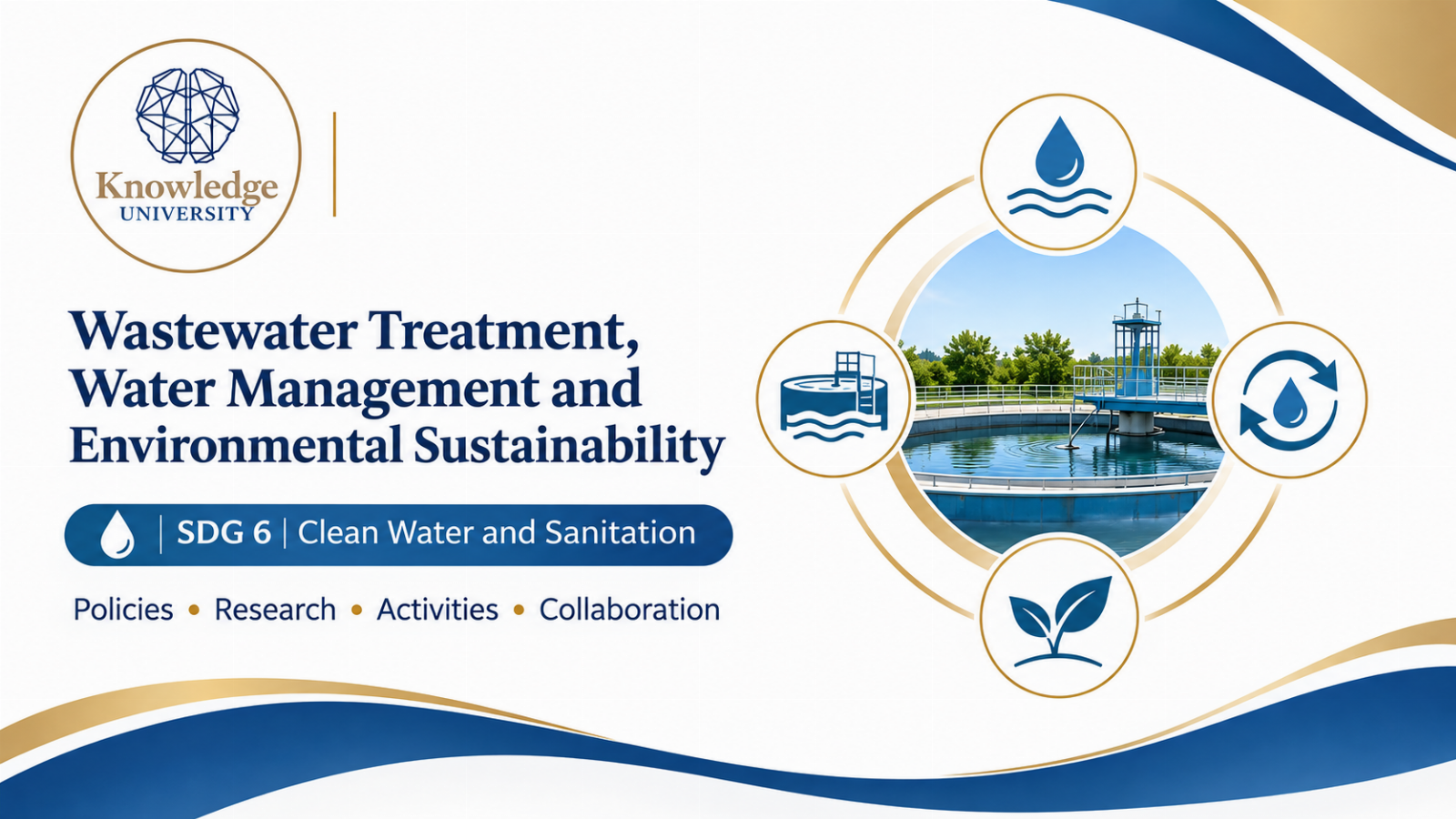
Knowledge University Advances Wastewater Management, Water Conservation and Environmental Sustainability – 2025
Knowledge University | Environmental Sustainability and Water Resource Management
SDG 6: Clean Water and Sanitation
Knowledge University is committed to advancing environmental sustainability, responsible water management, wastewater pollution prevention, and the protection of natural water resources through institutional policies, scientific research, academic activities, and collaboration with local and international organizations.
Throughout 2025, the university strengthened its engagement in environmental protection and sustainable water management through scientific publications, environmental awareness programmes, and institutional meetings addressing water security, wastewater treatment technologies, and pollution prevention.
These initiatives reflect Knowledge University's contribution to the United Nations Sustainable Development Goal 6 (Clean Water and Sanitation), particularly the promotion of water quality, sustainable water resource management, and awareness of wastewater treatment and environmental protection.
1. Institutional Commitment to Wastewater Management and Environmental Protection
Knowledge University recognizes that responsible wastewater management is essential to protecting public health, groundwater resources, soil quality, biodiversity, and surrounding ecosystems.
The university's environmental sustainability framework addresses the importance of proper wastewater handling, water pollution prevention, responsible discharge, and opportunities for water reuse and recycling.
Relevant areas of environmental management include:
- Prevention and reduction of water pollution.
- Responsible collection and handling of wastewater.
- Protection of groundwater and surrounding ecosystems.
- Appropriate management of wastewater generated by laboratories and campus facilities.
- Consideration of water quality standards and discharge requirements.
- Promotion of wastewater treatment and water recycling technologies.
- Environmental education and scientific research on sustainable water management.
Knowledge University has published relevant institutional policies addressing water discharge quality and water reuse, providing a foundation for its environmental management objectives.
2. Institutional Water Resources and Campus Sustainability
Knowledge University's campus water supply is supported by two underground groundwater wells, serving academic buildings, administrative facilities, sanitation, and landscape irrigation.
The campus contains extensive gardens, trees, flowers, and landscaped green spaces that require responsible water management, particularly during the hot and dry seasons.
The university recognizes the connection between responsible groundwater extraction, water conservation, wastewater management, and the protection of surrounding natural resources.
Sustainable water management remains an important consideration in the university's environmental planning and development.
3. Environmental Pollution and Public Health Awareness – February 2025
On 9 February 2025, the Department of Environmental Engineering at Knowledge University, in collaboration with the Kurdistan-Germany Friendship Association, organized a scientific panel discussion entitled:
"The Impact of Environmental Pollution on Citizens' Health: Causes and Solutions."
The event brought together experts, academics, students, and environmental stakeholders to discuss the environmental and public health consequences of pollution.
The panel addressed important topics including:
- Water pollution and its impact on public health.
- Environmental contamination and industrial waste.
- Waterborne illnesses and environmental health risks.
- Pollution prevention and possible technological solutions.
- Environmental protection and community awareness.
This activity contributed to scientific dialogue and public awareness regarding environmental pollution and the importance of effective pollution-control measures.
Official Activity: Environmental Pollution and Public Health Panel – 9 February 2025
4. Climate Change and Water Security Meeting – April 2025
On 27 April 2025, the College of Engineering at Knowledge University hosted a high-level meeting addressing climate change and water security in the Kurdistan Region of Iraq.
The meeting brought together the Governor of Erbil, environmental authorities, university leadership, academic staff, and experts in water resources, agriculture, and environmental studies.
The event highlighted the importance of coordinated approaches to regional water security, environmental protection, and sustainable resource management.
The discussion reinforced the role of academic institutions in addressing water-related environmental challenges through scientific expertise and cooperation with government and community stakeholders.
Official Activity: Climate Change and Water Security Meeting – 27 April 2025
5. Collaboration Discussions with UNICEF on Water Resources – September 2025
On 1 September 2025, Knowledge University hosted representatives of UNICEF to discuss potential collaboration on water resource management projects in Erbil.
The meeting involved Knowledge University leadership, academic specialists, and UNICEF representatives, including a hydrology officer.
Discussions focused on opportunities for financial and operational cooperation supporting university academic expertise and potential service projects related to Erbil's water resources.
This institutional engagement demonstrates the university's interest in contributing scientific expertise to regional water-management challenges and exploring partnerships addressing water security and environmental sustainability.
Official Activity: Knowledge University Visits UNICEF for Collaboration on Water Resources Projects – 1 September 2025
6. Scientific Research Supporting Wastewater Treatment Technologies – 2025
Knowledge University contributed to wastewater-related scientific knowledge through research publications by university researchers during 2025.
These publications address wastewater treatment technologies, removal of contaminants, and the potential recovery of useful resources from wastewater-derived materials.
Research 1: Magnetic Nanoparticles for Wastewater Treatment
Publication date: 28 January 2025
Researcher: Rebaz Anwar Omer
Title: "Use of Magnetic Nanoparticles for the Removal of Organic and Inorganic Pollution in Wastewater Treatment – A Review"
The study examines the use of magnetic nanoparticles as potential materials for removing organic and inorganic pollutants from wastewater.
This research contributes to understanding emerging wastewater treatment technologies and the potential application of nanomaterials in environmental pollution control.
Research 2: Removal of Pharmaceutical Contaminants from Wastewater
Publication date: 23 June 2025
Researcher: Rebaz Anwar Omer
Title: "A Review of Effective Nanoadsorbents Made of Carbonaceous, Metal Oxides, and Polymer Nanocomposite Materials for Adsorption of Pharmaceutical Contaminants in Wastewater"
This publication reviews nanomaterial-based adsorption technologies for removing pharmaceutical contaminants from wastewater.
The research supports scientific understanding of water purification technologies and methods for reducing potentially harmful substances in aquatic environments.
Research 3: Resource Recovery from Wastewater-Derived Sewage Sludge
Publication date: 29 September 2025
Researcher: Rebwar Nasir Dara
Title: "Optimizing Hydrogen Production from Wastewater-Derived Sewage Sludge via Alkali-Catalyzed Supercritical Water Gasification"
This research investigates the conversion of sewage sludge derived from municipal wastewater into hydrogen-rich gas using supercritical water gasification technologies.
The study explores potential methods for recovering valuable energy resources from wastewater-related waste materials, contributing to scientific discussions on sustainable waste management and resource recovery.
Collectively, these publications highlight Knowledge University's research contributions to wastewater pollution control, treatment innovation, and sustainable environmental technologies.
7. Institutional Policies Supporting Water Quality and Wastewater Management
Knowledge University has published policies relevant to responsible water resource management and environmental protection.
Water Discharge Quality Standards & Guidelines Policy
This policy provides an institutional reference for the importance of water discharge quality, pollution prevention, and the protection of human health and the environment.
View Water Discharge Quality Policy
Water Reuse & Recycling Policy
This policy addresses the university's institutional commitment to sustainable water management and the promotion of water reuse and recycling.
View Water Reuse & Recycling Policy
These policies complement the university's scientific research, environmental awareness programmes, and broader sustainability objectives.
8. Wastewater Management and Treatment Considerations
Knowledge University recognizes that effective wastewater management requires appropriate processes for the collection, handling, treatment, and safe disposal or reuse of wastewater.
Key technical considerations include:
- Wastewater Collection: Understanding the sources and collection pathways of wastewater generated by academic buildings, sanitation facilities, and laboratories.
- Wastewater Characterization: Identifying relevant physical, chemical, and biological characteristics of wastewater where necessary.
- Treatment Arrangements: Determining suitable treatment methods and responsible operators according to the wastewater characteristics and applicable environmental requirements.
- Water Quality Protection: Considering appropriate water quality standards before treated wastewater is discharged or reused.
- Environmental Monitoring: Evaluating environmental risks and promoting measures that protect groundwater, soil, and ecosystems.
- Documentation and Continuous Improvement: Maintaining appropriate technical records and identifying opportunities to improve wastewater management.
These considerations provide a technical framework for assessing and strengthening wastewater management. Confirmation of the specific treatment systems used for wastewater generated on campus requires supporting operational documentation.
9. Contribution to Sustainable Development Goals
Knowledge University's wastewater-related research, environmental activities, institutional policies, and water-security engagement contribute to several Sustainable Development Goals.
- SDG 6 – Clean Water and Sanitation: Promoting water quality, wastewater treatment research, pollution prevention, and sustainable water management.
- SDG 3 – Good Health and Well-being: Raising awareness of environmental pollution and its consequences for public health.
- SDG 9 – Industry, Innovation and Infrastructure: Contributing scientific research on advanced wastewater treatment technologies.
- SDG 12 – Responsible Consumption and Production: Supporting resource conservation and research on waste recovery.
- SDG 13 – Climate Action: Addressing climate change and regional water-security challenges.
- SDG 17 – Partnerships for the Goals: Encouraging collaboration with environmental organizations, government authorities, and international institutions.
10. Continuing Commitment to Sustainable Water Management
Knowledge University remains committed to strengthening environmental awareness, scientific research, cooperation, and responsible management of natural water resources.
The university's activities and scientific contributions during 2025 demonstrate engagement with important environmental issues, including water pollution, wastewater treatment technologies, water security, and sustainable resource utilization.
Through continued research, institutional cooperation, and improvement of environmental management practices, Knowledge University seeks to contribute to cleaner water resources, healthier ecosystems, and sustainable development in the Kurdistan Region of Iraq.
Reporting Year: 2025
Institution: Knowledge University, Erbil, Kurdistan Region, Iraq
Academic Units: College of Engineering and other contributing researchers
SDG Alignment: SDG 6 – Clean Water and Sanitation
Scope of Evidence: Institutional policies, environmental awareness activities, collaboration discussions, and wastewater-related scientific research. Campus-specific wastewater treatment arrangements require separate operational verification.